Self-consistent precession-nutation model of the Earth
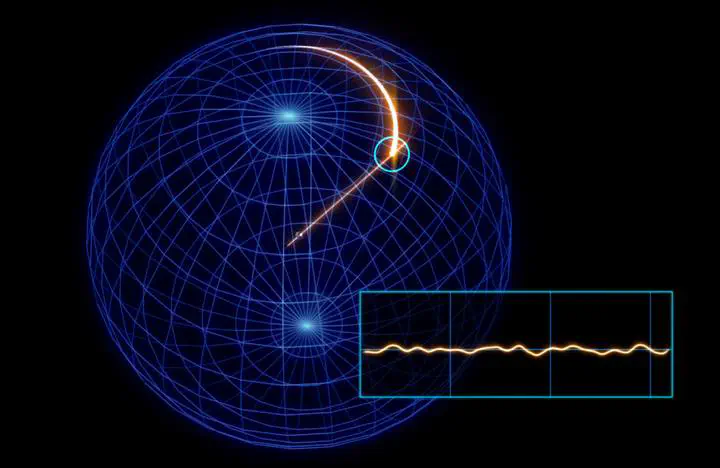
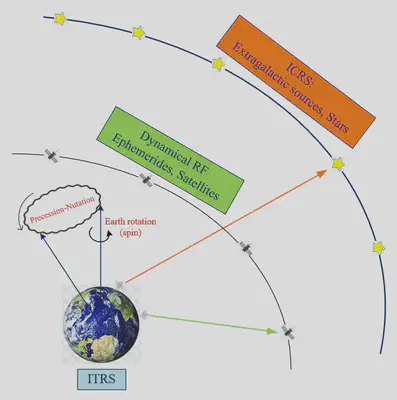
The precession-nutation model describes the precise orientation of Earth’s rotation axis in space and serves as an important theoretical foundation for deep-space exploration, satellite navigation, and geodesy, possessing strong frontier significance and broad application scenarios.
The current standard precession-nutation model of the International Astronomical Union (IAU) suffers from internal inconsistency in modeling Earth’s dynamical flattening, which results in a systematic deviation of approximately 200 microarcseconds between the model and VLBI observations, far falling short of the target accuracy on the order of 10 microarcseconds. Previous work by the research group, based on approximately 50 years of satellite laser ranging (SLR) data, has confirmed that Earth’s dynamical ellipticity exhibits a clear parabolic rather than linear variation, and the improved IAU2006_J2 precession model constructed on this basis will be considered for incorporation into the recently updated IERS (International Earth Rotation and Reference Systems Service) conventions.
On this basis, in the coming years the research group will systematically investigate the full effects of long-term nonlinear and periodic variations in Earth’s flattening on precession and nutation, and construct a dynamically self-consistent, reference-frame-compatible precession-nutation model. The Gaia optical reference frame with microarcsecond accuracy will be introduced as an independent celestial reference frame to overcome the difficulty that Earth rotation models lack external validation. This project aims to break through the limitations of existing theories and the current research status of fragmented patches, and to establish a new-generation precession-nutation model that is consistent with dynamical theory and highly accurate observations, striving to have the research results incorporated into IAU resolutions and IERS conventions, thereby enhancing China’s international influence and discourse power in the field of fundamental astronomy.