 Quality-indicator correlations in Gaia-CRF2 (Ding et al. 2020, A&A 635, A113)
Abstract
Dependences of the parallaxes and proper motions on several indicators of solution quality were investigated for the quasars in the Gaia-CRF2. Using astrometric statistics such as the number of visibility periods, the semi-major axis of the five-dimensional error ellipse (σ₅d,max), the unit-weight error u, and the correlation coefficients ρ(μₐ*, ϖ) and ρ(μδ, ϖ), we analysed how these parameters affect precision, reliability, and consistency. Quasars with fewer than 9 or more than 18 visibility periods show departures from the global mean. Astrometric parameters of the most precise sources also deviate from the average. Spherical-cell analyses reveal centrally asymmetric distributions of the correlation coefficients, likely induced by the Gaia scanning law. Quasars with 13–16 visibility periods and well-distributed correlation coefficients possess the most reliable astrometric parameters. Magnitude and colour have little impact on these irregular patterns.
This paper investigates the dependence of Gaia-CRF2 quasar astrometric parameters
on key quality indicators to evaluate the reliability of Gaia DR2 solutions.
Mean parallaxes, normalised proper-motion differences (Xₚₘ), and correlation
coefficients are examined across subsets defined by visibility periods,
σ₅d,max, and unit-weight error u.
Results indicate that the astrometric parameters of quasars with 13–16 visibility
periods are the most stable and reliable, while extremely precise or sparsely
observed sources tend to deviate from the global averages.
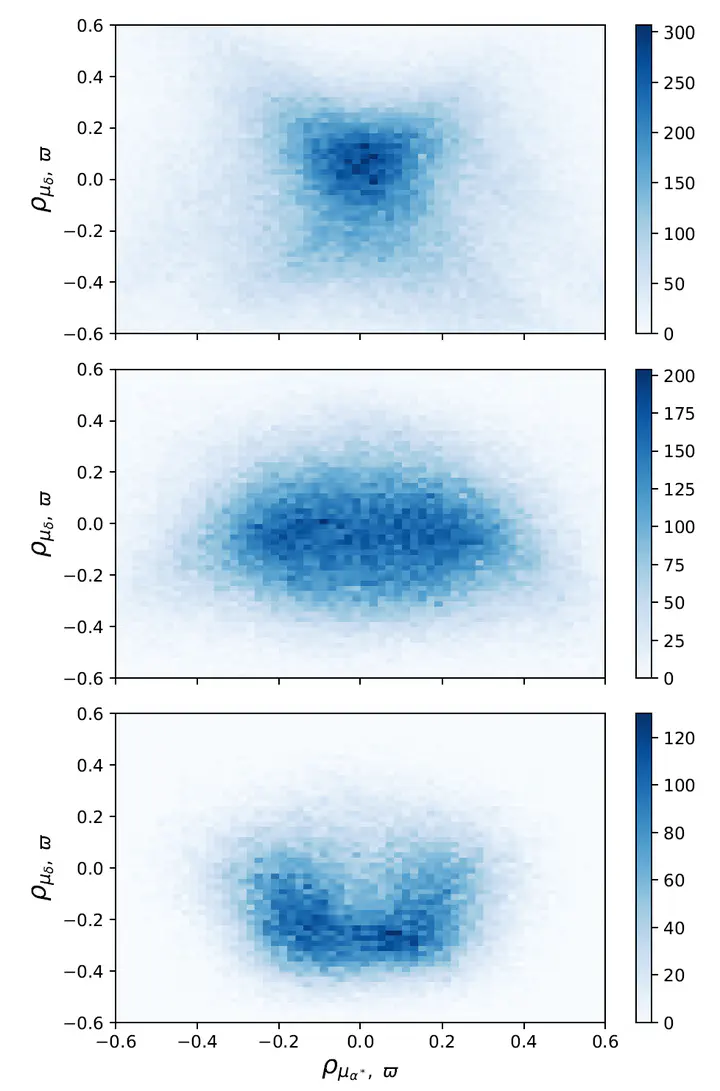
The correlation coefficients ρ(μₐ*, ϖ) and ρ(μδ, ϖ) exhibit centrally asymmetric
spatial distributions associated with the scanning law, a factor crucial for
evaluating Gaia-based celestial reference frames.
Citation:
Ding, C.-Y., Zhu, Z., Liu, J.-C., & Liu, N. (2020).
Revisiting astrometric parameters of quasars in Gaia-CRF2.
Astronomy & Astrophysics, 635, A113.
https://doi.org/10.1051/0004-6361/201937416

Cheng-Yu Ding
PhD Graduate (2020)

Zi Zhu
Professor
My research focuses on astrometric methods, astronomical reference systems, and Galactic astronomy.

Jia-Cheng Liu
Professor
My research interests include theoretical mechanics, space astrometry, and astronomical reference systems.

Niu Liu
Assistant Professor
My research focuses on astronomical reference systems, VLBI astrometry, space astrometry, and pulsar astrometry.