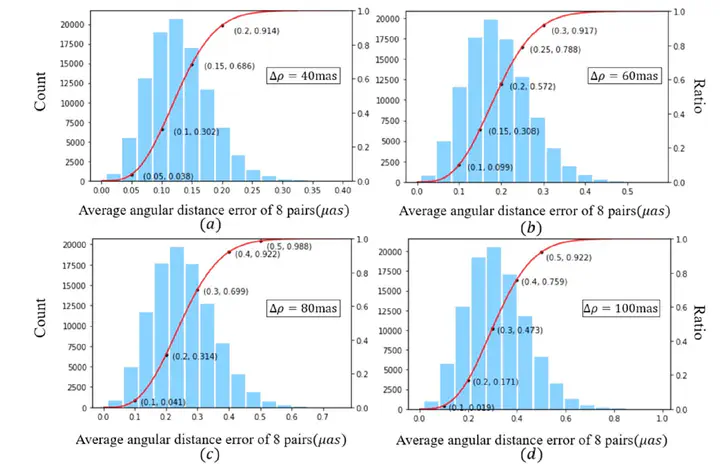
 Effect of optical-axis deviation on angular-distance precision (Tan et al. 2022, RAA 22:025008)
Abstract
For detecting exoplanets with high precision, the angular distance between two stars can be used to detect the periodic motion of a star, which avoids introducing catalog position errors from traditional photographic astrometry. At the microarcsecond precision level, the effect of optical axis deviation becomes non-negligible. This study evaluates the impact of optical axis stability on relative angular-distance measurements through theoretical analysis and numerical simulations. When the angular-distance error is limited to 1 μas, the upper limit of optical-axis deviation is found to be 68 milliarcseconds. The corresponding error allowance is given, and the impacts of CCD distortion and focal-length variation are discussed. The results provide design guidance for high-precision astrometric telescopes such as CHES.
High-precision astrometric detection of exoplanets requires extreme control of instrumental systematics.
Tan et al. (2022) analyzed the impact of optical-axis deviation on relative angular-distance measurements
between star pairs, combining theoretical derivations with numerical simulations.
They found that to maintain a precision of 1 μas in relative astrometry, the telescope’s optical-axis stability must be
better than 68 mas.
They further provided corresponding error budgets and mitigation strategies,
including field-of-view rotation to reduce distortion variations and laser-collimation systems to monitor focal-length changes.
These results offer quantitative constraints for the optical design of space astrometric missions such as CHES.
Citation:
Tan, D.-J., Liu, J.-C., Zhu, Z., & Liu, N. (2022). Evaluating the Impact of Optical Axis Stability on Exoplanet Detection.
Research in Astronomy and Astrophysics, 22:025008. https://doi.org/10.1088/1674-4527/ac3df1

Dong-Jie Tan
Master’s Graduate (2022)

Jia-Cheng Liu
Professor
My research interests include theoretical mechanics, space astrometry, and astronomical reference systems.

Zi Zhu
Professor
My research focuses on astrometric methods, astronomical reference systems, and Galactic astronomy.

Niu Liu
Assistant Professor
My research focuses on astronomical reference systems, VLBI astrometry, space astrometry, and pulsar astrometry.