Comparison of dynamical and kinematic reference frames via pulsar positions from timing, Gaia, and interferometric astrometry
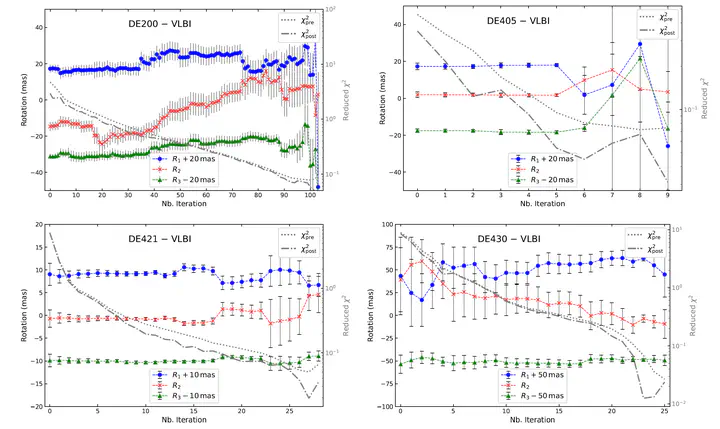 Orientation offsets of DE frames referred to the VLBI celestial frame. Image credit: A&A / NJU Astrometry Group
Abstract
Using pulsar positions measured independently by timing, VLBI, and Gaia, this paper assesses the orientation consistency between dynamical ephemeris-based frames (e.g., DE series) and the kinematic frames realized by Gaia and VLBI at sub-milliarcsecond precision.
Pulsars provide a unique bridge between dynamical (planetary ephemeris–based) and kinematic (Gaia/VLBI) celestial reference frames. By comparing pulsar positions from timing, VLBI, and Gaia, this study estimates orientation offsets between these frames and discusses systematics driven by sample composition (MSP vs. non‑MSP) and ecliptic‑latitude selection.

Niu Liu
Assistant Professor
My research focuses on astronomical reference systems, VLBI astrometry, space astrometry, and pulsar astrometry.

Zi Zhu
Professor
My research focuses on astrometric methods, astronomical reference systems, and Galactic astronomy.

Jia-Cheng Liu
Professor
My research interests include theoretical mechanics, space astrometry, and astronomical reference systems.