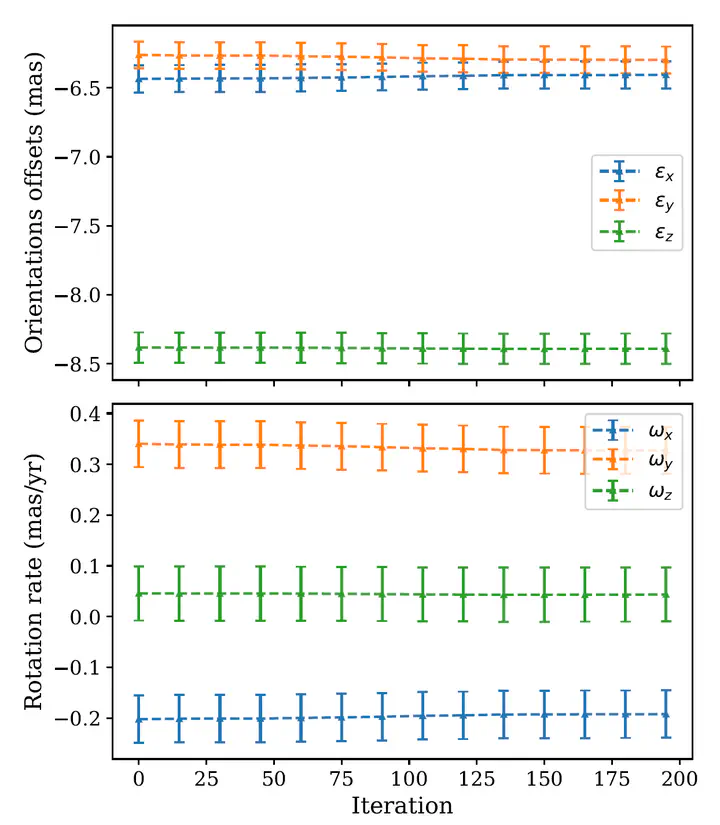
 Orientation offsets (~10 mas) from asteroid AL residual fits.
Abstract
We compare the optical Gaia celestial reference frame (Gaia-CRF3) with the dynamical reference frame defined by JPL’s planetary ephemerides using high-precision Gaia asteroid astrometry. From a cleaned sample of 1001 well-observed asteroids, least-squares fits to along-scan residuals yield orientation offsets of order ~10 mas and rotation rates < 0.5 mas yr⁻¹ in equatorial coordinates. Robustness checks (iterative transit rejection; model/sample variants) confirm the signal. When Gaia observations are included in orbit determination, the orientation offset drops to ~0.2 mas, indicating that historical asteroid astrometry (and catalog systematics therein) largely drives the larger offsets seen without Gaia.
Highlights
- 1001-asteroid Gaia sample; weighted fits in along-scan (AL) direction.
- Orientation offsets ≈ (−6.4, −6.3, −8.5) mas; rotation rates |ω| < 0.5 mas yr⁻¹.
- Incorporating Gaia in orbit determination reduces orientation offset to ≈ 0.2 mas.
Takeaway: Gaia asteroid astrometry sharply tightens the dynamical–kinematic frame tie; larger offsets mainly trace systematics in historical asteroid observations.

Jun Yao
PhD Graduate (2026)
My research focuses on the alignment of celestial reference frames realized by VLBI and Gaia, and planetary ephemeris reference frames.

Jia-Cheng Liu
Professor
My research interests include theoretical mechanics, space astrometry, and astronomical reference systems.

Niu Liu
Assistant Professor
My research focuses on astronomical reference systems, VLBI astrometry, space astrometry, and pulsar astrometry.

Zi Zhu
Professor
My research focuses on astrometric methods, astronomical reference systems, and Galactic astronomy.

Ibnu Nurul Huda
Former Postdoctoral Researcher
My research interests include Earth rotation, VLBI data analysis, reference systems, Earth tides, and celestial mechanics.