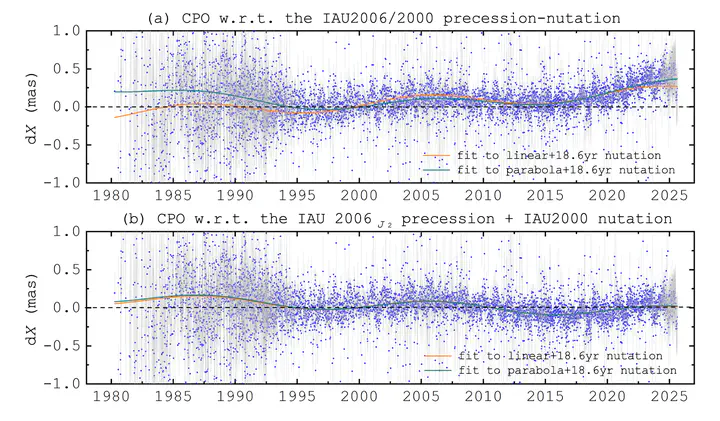
 Celestial pole offsets in $\mathrm{d}X$ after removing free core nutation.
Abstract
Context. In 2006, the IAU adopted a new precession theory, called the IAU 2006. The time variation of the Earth’s dynamical flattening $J_{2}$ was considered in this model as an important contribution to the precession rate in longitude. However, a linear $J_{2}$ trend, which was valid at that time, is no longer a good approximation and may limit the accuracy of the theory. Aims. We investigated the contribution of latest nonlinear $J_{2}$ variation in developing the precession quantities of the equator. Methods. Using the most recent satellite laser ranging data, we modeled the Earth’s $J_{2}$ long-term variation using a parabola. It was implemented in calculating the polynomial expressions for precession quantities with a method similar to the IAU 2006 approach. Results. The updated precession solution is clearly more consistent with VLBI observations and can reduce most of the curvature signals in the CPO series. The validity of using a parabolic $J_{2}$ variation in precession development is confirmed. Conclusions. The new precession can be regarded as an update of the IAU 2006 model, and thus we named it IAU $2006_{J_{2}}$. Since the improvement shown by the tests with VLBI observations is quite significant, we propose that a serious discussion for updating the IAU precession be carried out by the IAU/IAG Joint Working Group: Consistent Improvement of the Earth’s Rotation Theory (CIERT). It could also be considered for the next update of the IERS Conventions which took effect more than 15 years ago.
Updating the long-term variation of Earth’s oblateness
The IAU 2006 precession model incorporates a linear trend in Earth’s gravitational coefficient $J_{2}$, which characterizes its oblateness. However, satellite laser ranging observations extending from 1976 to 2025 show that the long-term evolution of $J_{2}$ is better represented by a parabola.
We use these observations to determine an updated empirical model of $J_{2}$ and incorporate it into the integration of the precession equations. The resulting solution, named IAU $2006_{J_{2}}$, follows the framework of the IAU 2006 model while updating the polynomial expressions for the precession quantities.
Main results
- A better-supported nonlinear trend: Nearly 50 years of satellite laser ranging data provide stronger evidence for a parabolic variation of $J_{2}$ than was available in earlier studies.
- Revised precession quantities: The updated $J_{2}$ model mainly changes the quadratic and cubic terms of the precession in longitude, while the precession in obliquity remains close to the IAU 2006 solution.
- Improved agreement with VLBI: Comparisons with the C04 and OPA2025a celestial pole offset series show that the updated model removes most of the residual curvature in $\mathrm{d}X$.
- Smaller residuals before empirical fitting: The weighted root-mean-square values decrease from 179 to 130 microarcseconds for C04 and from 193 to 147 microarcseconds for OPA2025a.
Implications
The results provide observational support for updating the precession model within the IAU 2006 framework. The paper proposes the solution for consideration by the IAU/IAG CIERT working group and in a future revision of the IERS Conventions.
Further work on the corresponding nutation corrections is needed to ensure consistency between precession and nutation when the time variation of Earth’s dynamical flattening is taken into account.

Jia-Cheng Liu
Professor
My research interests include theoretical mechanics, space astrometry, and astronomical reference systems.