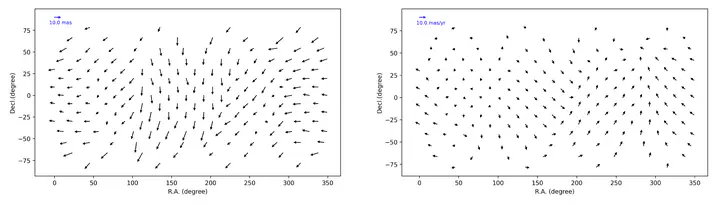
 Coordinate (left) and proper-motion (right) offsets between CatWISE2020 and Gaia DR3.
Abstract
Context. The International Celestial Reference System (ICRS) is currently realized by radio (ICRF3) and optical (Gaia-CRF3) reference frames, while an infrared reference frame is still missing. Aims. We aim to establish an infrared celestial reference frame using the CatWISE2020 catalog and investigate its alignment with Gaia DR3 data. Methods. We cross-matched 1.89 billion CatWISE2020 sources with Gaia DR3 and Gaia-CRF3 sources from five- or six-parameter astrometric solutions. We performed a vector-spherical-harmonics (VSH) analysis on positional and proper-motion differences for common sources. Results. The global rotation and glide between CatWISE2020 and Gaia DR3 are found to be 6.6 and 6.9 mas for position system, and 1.9 and $2.7,\mathrm{mas,yr^{-1}}$ for proper motion system. Internal differences between stellar frame and extragalactic frame in CatWISE2020 are found to be approximately 6 mas for position and approximately $1,\mathrm{mas,yr^{-1}}$ for proper motion. Magnitude-dependent systematic differences on positions and proper motions are also presented. Conclusions. So far, the CatWISE2020 catalog is the best available comprehensive infrared all-sky survey with the highest astrometric accuracy. After correcting for systematic errors with respect to the Gaia celestial reference frame, it can serve as an infrared realization of the ICRS.
An infrared extension of the celestial reference frame
The International Celestial Reference System is currently realized primarily in the radio and optical bands. An infrared realization would extend its wavelength coverage and provide a denser reference grid in regions affected by strong interstellar extinction, such as the Galactic plane and bulge.
In this study, we cross-matched CatWISE2020 with Gaia DR3, identifying approximately 404 million common sources, including 1.38 million Gaia-CRF3 quasars. We investigated their positional and proper-motion differences using vector spherical harmonics, with separate analyses for stellar and extragalactic sources.
Main results
- Large-scale systematic offsets: For stellar sources, the rotation and glide amplitudes relative to Gaia DR3 are approximately 6.6 and 6.9 mas in position, and 1.9 and $2.7,\mathrm{mas,yr^{-1}}$ in proper motion.
- Internal frame differences: The stellar and extragalactic reference frames within CatWISE2020 differ by approximately 6 mas in position and $1,\mathrm{mas,yr^{-1}}$ in proper motion.
- Magnitude-dependent systematics: The offsets vary significantly with magnitude, indicating that a single global correction cannot fully describe the systematic differences. No significant color dependence was found.
- Underestimated uncertainties: The reported positional uncertainties are underestimated by factors of approximately 1.5–2.5.
The featured figure illustrates the spatial distribution of the positional and proper-motion offsets. Averaging the offsets within 192 equal-area sky pixels reveals coherent patterns, demonstrating the need to account for large-scale systematics when linking CatWISE2020 to Gaia.
Implications
After correcting systematic offsets relative to Gaia, CatWISE2020 can serve as an infrared realization of the ICRS. Its deeper coverage and improved proper motions offer substantial advantages over AllWISE. However, global corrections do not remove all tile-dependent systematics, and the comparatively large proper-motion uncertainties limit the long-term stability of the frame. Further improvements will require refined calibration and, ultimately, higher-precision infrared astrometry.

Zhen-Wei Wang
PhD Student
My research interests include celestial reference frames, astrometric catalogues, extragalactic sources, and VLBI astrometry.

Jia-Cheng Liu
Professor
My research interests include theoretical mechanics, space astrometry, and astronomical reference systems.

Niu Liu
Assistant Professor
My research focuses on astronomical reference systems, VLBI astrometry, space astrometry, and pulsar astrometry.

Zi Zhu
Professor
My research focuses on astrometric methods, astronomical reference systems, and Galactic astronomy.

Jun Yao
PhD Graduate (2026)
My research focuses on the alignment of celestial reference frames realized by VLBI and Gaia, and planetary ephemeris reference frames.

Ibnu Nurul Huda
Former Postdoctoral Researcher
My research interests include Earth rotation, VLBI data analysis, reference systems, Earth tides, and celestial mechanics.

Xia-Xuan Zhang
PhD Student
My research interests include celestial reference frames, temporal variations in extragalactic source positions, and VLBI astrometry.

Hua-Feng Yu
PhD Student
Hua-Feng Yu is a PhD student interested in astrometric catalogs, celestial reference frames, secular parallax, and stellar distance measurements.