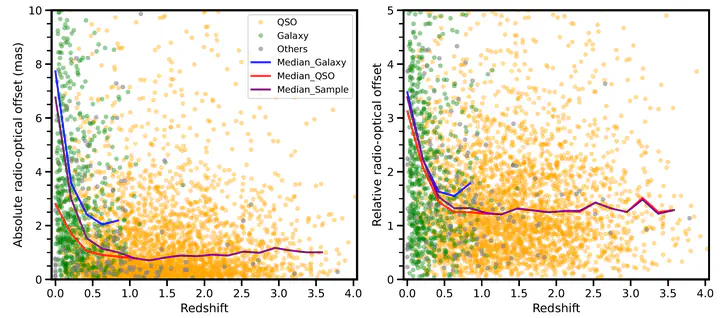
 Absolute radio–optical offsets (left) and error-normalised radio–optical offsets (right) as functions of redshift.
Abstract
We investigate the redshift dependence of radio and optical astrometric properties using compact radio sources from the Radio Fundamental Catalogue (RFC). Combining DESI DR1 and SDSS DR17/DR19 spectroscopy with literature data, we compile redshifts for 9907 RFC sources. Quality selection and cross-matching with Gaia DR3 yield a final sample of 4068 sources with reliable spectroscopic redshifts. Within the achieved precision, VLBI positional uncertainties, structure indices, and compactness show no significant dependence on redshift. In contrast, absolute radio-optical offsets and several Gaia astrometric quantities exhibit clear redshift-dependent trends. These trends can be largely explained by the dependence of Gaia astrometric performance on G magnitude, the variation of G magnitude with redshift, and differences between galaxies and quasi-stellar objects. Extended source morphology contributes additional optical astrometric uncertainties.
Sample and analysis
Starting from 21,949 compact radio sources in RFC release rfc_2025c, we compile redshifts for 9907 objects using DESI DR1, SDSS DR17/DR19, and literature data. After spectroscopic quality checks and cross-matching with Gaia DR3, the final sample contains 4068 sources, including 934 ICRF3 sources. Spectral classifications identify 784 galaxies, 3151 quasi-stellar objects (QSOs), and 133 sources with stellar or inconsistent classifications.
Main results
- VLBI positional uncertainties, radio structure indices, and compactness show no significant redshift dependence within the current precision.
- Median absolute radio-optical offsets decrease markedly over $0<z<0.5$, decline more gradually over $0.5<z<1.3$, and show a mild increase at $z>1.3$.
- The optical trends largely reflect Gaia’s magnitude-dependent astrometric performance and the changing mixture of galaxies and QSOs. Galaxies have larger optical astrometric uncertainties even at a fixed $G$ magnitude, indicating an additional contribution from extended morphology.
- The nearly constant median error-normalised proper motion of approximately 1.2 at $z>0.5$ is consistent with the observed proper motions being dominated by random measurement uncertainties.
These results help distinguish observational and source-population effects from an intrinsic dependence on redshift when evaluating sources for the optical–radio reference frame connection.

Zhi-Yun Zhang
PhD Student
My research interests include astronomical reference frames, binary systems, extragalactic sources, and VLBI astrometry.

Niu Liu
Assistant Professor
My research focuses on astronomical reference systems, VLBI astrometry, space astrometry, and pulsar astrometry.

Xia-Xuan Zhang
PhD Student
My research interests include celestial reference frames, temporal variations in extragalactic source positions, and VLBI astrometry.

Ibnu Nurul Huda
Former Postdoctoral Researcher
My research interests include Earth rotation, VLBI data analysis, reference systems, Earth tides, and celestial mechanics.

Zi Zhu
Professor
My research focuses on astrometric methods, astronomical reference systems, and Galactic astronomy.

Jia-Cheng Liu
Professor
My research interests include theoretical mechanics, space astrometry, and astronomical reference systems.

Jun Yao
PhD Graduate (2026)
My research focuses on the alignment of celestial reference frames realized by VLBI and Gaia, and planetary ephemeris reference frames.

Zhen-Wei Wang
PhD Student
My research interests include celestial reference frames, astrometric catalogues, extragalactic sources, and VLBI astrometry.

Hua-Feng Yu
PhD Student
Hua-Feng Yu is a PhD student interested in astrometric catalogs, celestial reference frames, secular parallax, and stellar distance measurements.

Da-Ding Zhang
Master’s Student
My research interests include celestial reference frames, astrometric catalogues, and autonomous celestial navigation.