Detections of Nearly Bias-free Core Shifts with 5–30 μas Precisions at 8–43 GHz in BL Lacertae
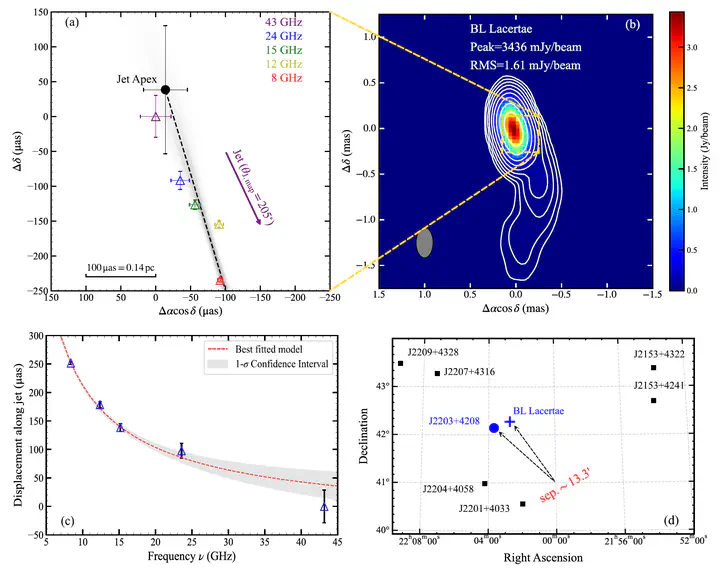 Core-shift measurements of BL Lacertae.
Abstract
We measure frequency-dependent core shifts in BL Lacertae using VLBA observations at 8.4, 12.4, 15.2, 23.6, and 43.2 GHz. Inverse phase referencing to the nearby steep-spectrum source NVSS J220340+420839, separated by only 13.3 arcmin, provides nearly bias-free two-dimensional measurements with precisions of 5–30 μas and detections exceeding 3σ significance. The displacement between 8.4 and 43.2 GHz reaches approximately 250 μas. A power-law fit gives a core-shift index of 1.18, with lower and upper uncertainties of 0.34 and 0.59, respectively. This result is consistent with the canonical value of unity expected under equipartition between particle and magnetic energy densities, while allowing modest departures during the observed flaring state.
Observations and method
The apparent radio core of an active galactic nucleus can shift with observing frequency because of opacity in the inner jet. Measuring this displacement provides a way to investigate the jet origin and its physical conditions.
We observed BL Lacertae with the VLBA on 27 July 2024 at 8.4, 12.4, 15.2, 23.6, and 43.2 GHz. The nearby source NVSS J220340+420839, only 13.3 arcmin away, provides a compact, steep-spectrum reference. Its measured spectral index of $-1.27\pm0.02$ supports its use as an optically thin reference source.
Using inverse phase referencing, calibration solutions derived from bright BL Lacertae are transferred to the weaker reference source. The differential positions then yield two-dimensional core shifts relative to the 43.2 GHz core, under the assumption that the reference-source position is frequency independent.
Main results
- Nearly bias-free two-dimensional core shifts are detected with 5–30 μas precision and greater than 3σ significance.
- The core displacement between 8.4 and 43.2 GHz reaches approximately 250 μas.
- The frequency dependence follows $r\propto\nu^{-1/k_r}$, with a fitted index of $k_r=1.18^{+0.59}_{-0.34}$.
- The fitted index is consistent within uncertainties with $k_r=1$, as expected for a canonical jet in equipartition between particle and magnetic energy densities. The uncertainties also allow modest departures from this condition during the flaring state.
The close reference source reduces differential calibration errors and enables an independent measurement of the core shift, particularly between 23.6 and 43.2 GHz. These observations provide new constraints on the innermost jet of BL Lacertae and demonstrate the potential of nearby steep-spectrum calibrators for high-precision multifrequency VLBI astrometry.

Niu Liu
Assistant Professor
My research focuses on astronomical reference systems, VLBI astrometry, space astrometry, and pulsar astrometry.

Xia-Xuan Zhang
PhD Student
My research interests include celestial reference frames, temporal variations in extragalactic source positions, and VLBI astrometry.

Jia-Cheng Liu
Professor
My research interests include theoretical mechanics, space astrometry, and astronomical reference systems.

Zi Zhu
Professor
My research focuses on astrometric methods, astronomical reference systems, and Galactic astronomy.