Astronomical determination of the Earth's dynamical flattening using VLBI observations and IAU 2006/2000 Precession-Nutation Model
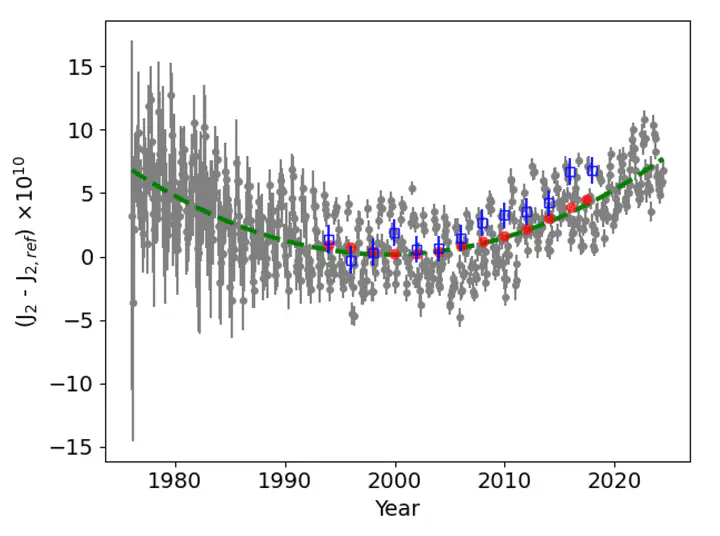 Comparison of J₂ variations derived from satellite laser ranging (SLR) and VLBI.
Abstract
We determine the Earth’s dynamical flattening from celestial intermediate pole coordinates constructed using the IAU 2006/2000 precession-nutation model and VLBI celestial pole offsets. The method accounts for the dependence of several precession-rate components and the main nutation term on dynamical flattening, providing a consistent estimate for precession and nutation. We obtain a dynamical flattening of 0.00327380936 with a formal uncertainty of $5 \times 10^{-11}$, differing from the IAU 2006 adopted value by approximately 4.54 ppm. The simultaneously estimated frame-bias components agree with the IAU model. A sliding-window analysis also recovers a broadly parabolic long-term variation in J₂, generally consistent with independent satellite laser ranging results.
Background and method
The Earth’s dynamical flattening, $H_{\mathrm d}$, describes the distribution of its principal moments of inertia and is a fundamental parameter in precession-nutation theory:
$$ H_{\mathrm d}=1-\frac{A+B}{2C}, $$
where $A$ and $B$ are the equatorial principal moments of inertia and $C$ is the axial moment.
We estimate this parameter directly from celestial intermediate pole (CIP) coordinates obtained by combining the IAU 2006/2000 precession-nutation model with VLBI celestial pole offsets. The analysis considers four individual analysis-centre series and the IERS C04 combined series, with free core nutation removed before fitting.
The method explicitly accounts for the dependence of several precession-rate contributions and the main nutation term on $H_{\mathrm d}$, while incorporating additional theoretical corrections. This provides a consistent determination of dynamical flattening within the precession-nutation framework.
Main results
- The estimated dynamical flattening is $H_{\mathrm d}=0.00327380936\pm5\times10^{-11}$, with the quoted uncertainty being formal. This differs from the IAU 2006 adopted value by approximately 4.54 ppm.
- The simultaneously estimated frame-bias components are $\delta X=-16603\pm8,\mu\mathrm{as}$ and $\delta Y=-7033\pm8,\mu\mathrm{as}$, in good agreement with the IAU model.
- A separate analysis using 15-year sliding windows with a 2-year step estimates long-term changes in $H_{\mathrm d}$ and converts them to changes in the Earth’s second zonal gravity coefficient, $J_2$, under the adopted relationship.
- The VLBI-derived $J_2$ variations show a broadly parabolic long-term trend, generally consistent with smoothed satellite laser ranging results, although differences remain for some windows.
These results demonstrate the value of VLBI precession-nutation observations as an independent probe of long-term changes in the Earth’s dynamical figure and provide observational constraints for further refinement of Earth-rotation models.

Ibnu Nurul Huda
Former Postdoctoral Researcher
My research interests include Earth rotation, VLBI data analysis, reference systems, Earth tides, and celestial mechanics.

Jia-Cheng Liu
Professor
My research interests include theoretical mechanics, space astrometry, and astronomical reference systems.

Niu Liu
Assistant Professor
My research focuses on astronomical reference systems, VLBI astrometry, space astrometry, and pulsar astrometry.

Jun Yao
PhD Graduate (2026)
My research focuses on the alignment of celestial reference frames realized by VLBI and Gaia, and planetary ephemeris reference frames.