Contribution of APSG VLBI Program in Monitoring Radio Telescope Motion Across Asia-Pacific Region
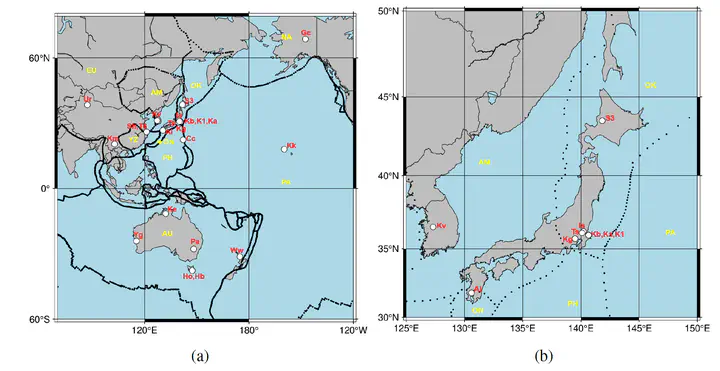 Spatial distribution of VLBI stations participating in APSG sessions across tectonic plates.
Abstract
We assess the contribution of the Asia-Pacific Space Geodynamics (APSG) VLBI program to station-motion estimation and regional crustal-deformation monitoring. Using 54 APSG sessions involving 22 stations between 1997 and 2024, we examine station coordinate time series, baseline-length variations, and global station-velocity solutions. APSG-derived time series are consistent with those from other VLBI sessions, with median formal uncertainties approximately 15% smaller. Including APSG sessions in the global velocity solution reduces formal uncertainties at several stations by up to 25%. The estimated velocities agree with ITRF2020, while differences from the MORVEL geological plate-motion model at some stations indicate sensitivity to regional deformation. APSG strengthens the geodetic VLBI network through direct East Asia–Australia baselines and increased participation of regional stations.
Background and approach
The Asia-Pacific Space Geodynamics (APSG) program uses space-geodetic observations to investigate plate motion and crustal deformation in the Asia-Pacific region. Its VLBI campaigns provide direct measurements of station positions and inter-station baselines, complementing the global geodetic VLBI network.
We analyse 54 APSG sessions conducted between October 1997 and September 2024, involving 22 stations. The study compares session-wise station coordinates and baseline lengths with those derived from other VLBI observations, evaluates the effect of including APSG sessions in global station-velocity solutions, and compares the estimated velocities with ITRF2020 and the MORVEL geological plate-motion model.
Main results
- APSG station coordinate time series and baseline-length variations are consistent with those from other VLBI sessions. Station-coordinate formal uncertainties are generally about 15% smaller.
- APSG improves network geometry by providing East Asia–Australia baselines and increasing the participation of several regional stations.
- Including APSG sessions in global station-velocity estimation reduces formal uncertainties at several stations by up to 25%.
- APSG-derived velocities agree with ITRF2020, particularly in the horizontal components. Differences from MORVEL at some stations point to regional deformation that is not fully represented by a geological plate-motion model.
- The limited number and cadence of APSG sessions constrain the detection of seasonal signals. Vertical velocity differences between solutions are also larger than horizontal differences.
The results demonstrate the value of sustained regional VLBI observations for monitoring station motion and supporting terrestrial reference frames. The quoted uncertainty reductions concern formal uncertainties rather than an independently established improvement in absolute accuracy.

Ibnu Nurul Huda
Former Postdoctoral Researcher
My research interests include Earth rotation, VLBI data analysis, reference systems, Earth tides, and celestial mechanics.

Jia-Cheng Liu
Professor
My research interests include theoretical mechanics, space astrometry, and astronomical reference systems.

Niu Liu
Assistant Professor
My research focuses on astronomical reference systems, VLBI astrometry, space astrometry, and pulsar astrometry.

Jun Yao
PhD Graduate (2026)
My research focuses on the alignment of celestial reference frames realized by VLBI and Gaia, and planetary ephemeris reference frames.

Zhen-Wei Wang
PhD Student
My research interests include celestial reference frames, astrometric catalogues, extragalactic sources, and VLBI astrometry.

Nabila Sofia Eryan Putri
Postdoctoral Researcher
My research focuses on tropospheric delay modelling, GNSS meteorology, and atmospheric water vapour monitoring.