Astrometric Systematic Errors as a Limiting Factor in Stellar-Aberration-Based Autonomous Navigation
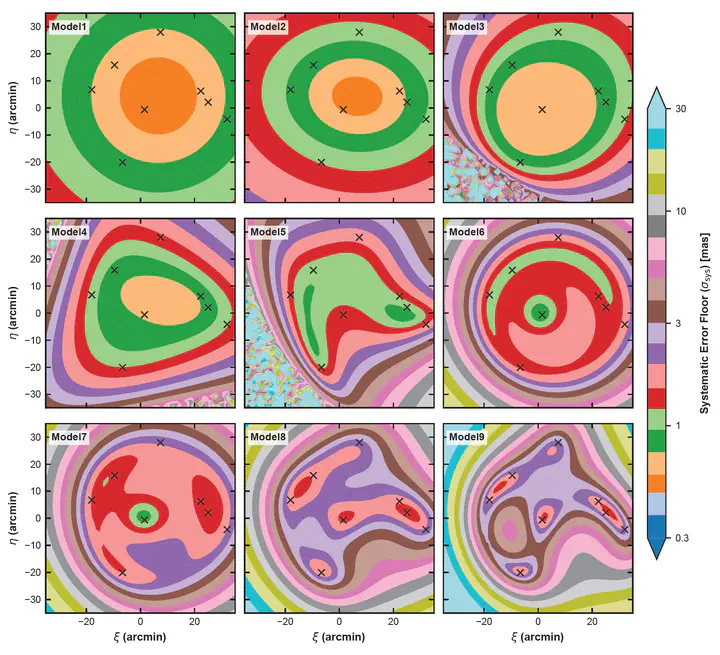 Spatial distribution of the positional uncertainty due to plate-constant variance (σ_pcv) in the selected fiducial field of view (Pixel 47), containing eight reference stars.
Abstract
Stellar-aberration-based autonomous navigation requires milliarcsecond-level angular measurements, making astrometric calibration an important part of its error budget. Using Gaia DR3 reference stars, HEALPix all-sky sampling, and covariance propagation to J2026.0, we evaluate the plate-solution uncertainty of nine polynomial plate models under a representative approximately one-degree sparse-field configuration. For the adopted G < 10 mag sample, the four-parameter linear model gives the lowest plate-constant variance, with a median positional uncertainty of 0.95 mas and a 95th percentile of 1.7 mas. Its low variance does not imply that it adequately corrects nonlinear optical distortion. A first-order conversion gives an approximate velocity-error scale of 0.9–2.5 m/s, highlighting the need to include plate-solution uncertainty and residual distortion bias explicitly in StarNAV error budgets and navigation filters.
Motivation and approach
Stellar-aberration-based navigation (StarNAV) estimates spacecraft velocity from velocity-induced changes in the apparent angular separations between stars. Achieving metre-per-second velocity sensitivity requires milliarcsecond-level angular measurements, so uncertainty in the transformation from focal-plane coordinates to celestial directions must be assessed alongside sensor noise and astrometric catalog errors.
We select 477,502 Gaia DR3 stars with $G<10$ mag and propagate their positions and covariances to J2026.0. Using HEALPix with $N_{\mathrm{side}}=64$, we divide the sky into 49,152 fields of approximately $0.84,\mathrm{deg}^{2}$ each, representing the adopted approximately one-degree field scale. The median field contains about eight reference stars. We compare nine plate models to quantify the effects of model complexity, reference-star density, and spatial distribution on plate-solution uncertainty.
Main results
- Under the plate-constant-variance metric, the four-parameter linear model is the most stable option for the adopted sparse fields. The median propagated positional uncertainty is 0.95 mas, and the 95th percentile is 1.7 mas.
- More complex models are more sensitive to limited reference-star counts and uneven spatial distributions. Additional distortion terms can increase variance or cause poorly conditioned solutions.
- Using the first-order scaling $\delta v \sim c,\delta\theta$, the reported angular-uncertainty range of 0.6–1.7 mas corresponds to an approximate velocity-error scale of 0.9–2.5 m/s, with a median of about 1.4 m/s.
- Low plate-constant variance does not guarantee adequate correction of real optical distortion. A linear model can leave nonlinear distortion biases that are not included in the variance calculation.
The velocity conversion is an order-of-magnitude estimate of the plate-solution contribution, not a prediction or lower bound for the complete navigation solution. Future StarNAV systems should jointly account for plate-solution uncertainty, residual distortion bias, measurement geometry, sensor noise, and catalog errors.

Da-Ding Zhang
Master’s Student
My research interests include celestial reference frames, astrometric catalogues, and autonomous celestial navigation.

Niu Liu
Assistant Professor
My research focuses on astronomical reference systems, VLBI astrometry, space astrometry, and pulsar astrometry.